


RESPs Explained: How to Save, Maximize Grants and Use the Money Strategically
Back-to-school season naturally gets families thinking about education.
For parents of younger children, university or college may still feel years away. For parents of teenagers, that future can suddenly feel very close.
Either way, one question eventually comes up:
How are we going to pay for it?
A Registered Education Savings Plan (RESP) is one of the main tools available to Canadian families to prepare for post-secondary education. But an RESP is much more than simply an account where parents deposit money.
Used thoughtfully, it can combine your own savings, government incentives and investment growth over many years.
And when the time comes to use the money, there are important decisions around how and when funds are withdrawn.
That is why we believe families should think about an RESP in three stages: Save → Grow → Withdraw
Each stage deserves some planning.
What exactly is an RESP?
An RESP is a registered account designed to help save for education after high school.
A parent can open one for a child, but parents aren’t the only people who can be subscribers. Grandparents, other relatives and even friends may also open an individual RESP.
There are different types of plans, including individual and family RESPs.
For most new accounts, the person opening the RESP will need a Social Insurance Number (SIN), and the child will also need a valid SIN. The beneficiary generally needs to be a resident of Canada when they are named on the plan and when contributions are made in order to receive federal education savings incentives.
For families who recently arrived in Canada, this is particularly important.
Pro Tip: Once your child’s SIN is available, don’t assume you need to wait several years before thinking about an RESP. The earlier you understand the available grants and your family’s contribution strategy, the more options you may have.
The first major advantage: government grants
This is where RESPs become particularly interesting.
Your RESP contribution itself does not create an income-tax deduction like an RRSP contribution does.
Instead, eligible RESP contributions can attract government education savings incentives.
Canada Education Savings Grant — CESG
The basic Canada Education Savings Grant generally adds 20% to the first $2,500 contributed for an eligible child each year.
That means:
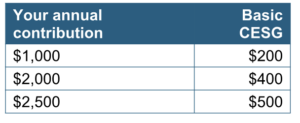
The lifetime CESG maximum is $7,200 per beneficiary.
Depending on family income, some children may also qualify for an additional CESG on the first $500 contributed each year.
This is why contribution planning matters.
Putting significantly more than $2,500 into an RESP during a regular year doesn’t automatically produce more basic CESG.
There may, however, be an important exception.

Started late? You may be able to catch up
This is something many parents don’t realize.
Unused basic CESG room can carry forward.
Suppose you have a 9-year-old child and haven’t contributed to an RESP for several years.
You haven’t necessarily lost all of those years of grant opportunity.
When unused grant room exists, an eligible beneficiary can generally receive up to $1,000 of basic CESG in one year, rather than the usual $500. That could mean contributing as much as $5,000 in a year to use the current year’s basic grant opportunity plus unused room from a previous year.
Example: two different families
Family A — starting early
They decide that $2,500 per year fits their budget.
Instead of waiting until December, they automate approximately $209 per month.
Over the year, they reach roughly $2,500 and may receive up to $500 in basic CESG.
Family B — starting later
Their child is older and has unused CESG room.
Depending on their situation, they decide to contribute approximately $5,000 during the year.
That may allow them to receive up to $1,000 in basic CESG and gradually catch up on previous unused room.
The important word is gradually.
You generally cannot catch up on many years of basic CESG simply by making one very large contribution in a single year.
An important rule for parents of teenagers
If your child is already approaching 15, timing becomes particularly important.
For a 16- or 17-year-old to continue qualifying for CESG, certain minimum contributions generally need to have been made before the end of the calendar year in which the child turns 15.
There are specific tests based on either prior total contributions or contributions made during multiple earlier years.
This is one of those situations where waiting another year can materially change the available strategy.
If your child is approaching that age and you haven’t started an RESP yet, this is worth reviewing sooner rather than later.
Some families may qualify for money without contributing anything
Another often-overlooked program is the Canada Learning Bond (CLB).
Eligible children from lower-income families may receive up to $2,000 through the CLB.
Most importantly:
Parents do not need to make personal RESP contributions to qualify for the CLB.
Eligibility is based on factors including family income, residency and the child’s SIN.
For some families, simply opening the right RESP and applying for available benefits can unlock education savings they may not have known existed.
A special opportunity for B.C. families
Families living in British Columbia should also be aware of the B.C. Training and Education Savings Grant (BCTESG).
Eligible children may receive a one-time $1,200 grant deposited into an RESP.
The child and parent or guardian must generally be B.C. residents, and the application window runs from the child’s 6th birthday until the day before the child turns 9.
No personal contribution is required to receive the BCTESG.
That’s an important deadline because once the eligibility window closes, the opportunity can be lost.
Pro Tip for B.C. parents: If you have a child between 6 and 8 years old, check whether the BCTESG has already been received. Don’t simply assume that having an RESP means the provincial grant was automatically added.
RESP or TFSA: why not simply save the money elsewhere?
We hear variations of this question regularly.
A TFSA is an excellent savings vehicle, but it serves a different purpose.
The better question isn’t:
“Which account is better?”
It is:
“What are we trying to accomplish with this money?”
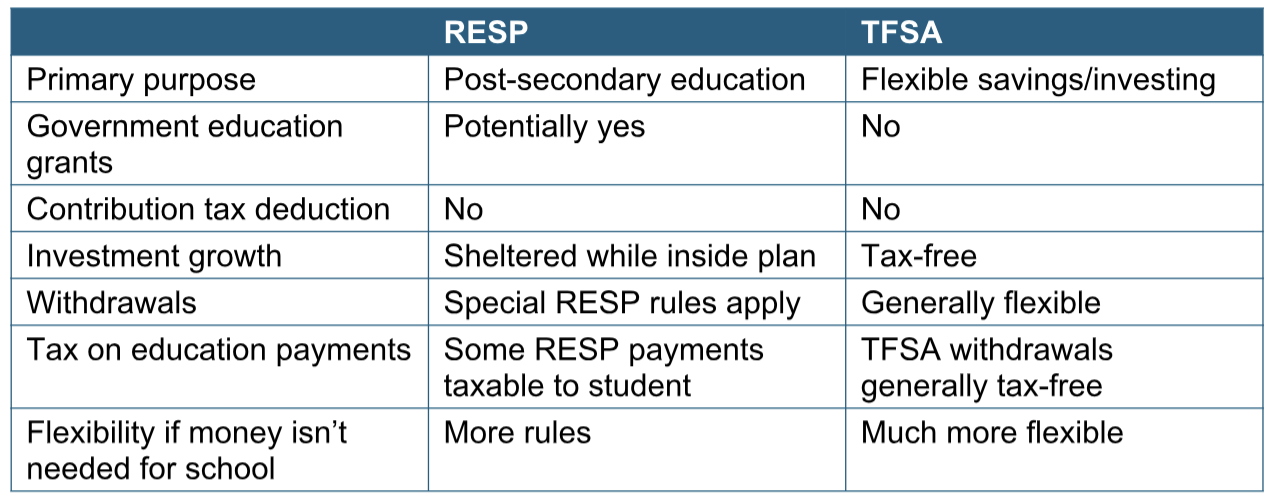

For a family specifically saving for a child’s education, the government grants available through an RESP can be an important consideration.
But flexibility matters too.
Depending on the family’s goals, cash flow, available TFSA room, the child’s age and how certain the education objective is, these accounts may sometimes be used together rather than viewed as competitors.
This is where planning becomes more useful than simply choosing an account.
Opening the RESP is only the first decision
An RESP is an account structure.
It isn’t, by itself, an investment strategy.
A child who is two years old has a very different time horizon from a child who will start university next September.
That matters.
When education is many years away, a family may have more time to tolerate normal investment-market fluctuations.
As the education date approaches, protecting money that may soon be needed becomes increasingly important.
This is why an RESP strategy should ideally evolve with the child.
Questions worth reviewing periodically include:
- How many years remain until the money will be needed?
- How much has already been saved?
- How much CESG remains available?
- Has the family’s monthly cash flow changed?
- Has the child’s likely education timeline changed?
- Is the investment risk still appropriate for the remaining timeframe?
The strategy that made sense when your child was three may not be the strategy you want when they are seventeen.
The part many families overlook: withdrawing from the RESP
Families understandably spend years thinking about how to put money into an RESP.
Far fewer think ahead about how the money will eventually come out.
That can be just as important.
RESP money essentially contains different buckets.
Bucket 1 — Your contributions
The money originally contributed by the subscriber can generally be withdrawn tax-free.
Bucket 2 — Government benefits and investment earnings
Government incentives plus accumulated investment earnings are generally paid to the student as Educational Assistance Payments (EAPs).
EAPs are taxable income to the student and are reported on a T4A.
Because many students have relatively modest taxable income while studying, the actual tax can sometimes be limited.
But that doesn’t mean withdrawal planning should be ignored.
Why withdrawal strategy matters
Consider two families with the same RESP balance.
Scenario A — Student begins full-time university
During the first 13 consecutive weeks of a qualifying full-time program, EAP withdrawals are generally limited to $8,000.
Once those first 13 consecutive weeks have been completed and the student remains eligible, that initial EAP limit generally no longer applies.
That creates planning questions such as:
- How much should come from EAPs?
- How much should come from original contributions?
- Does the student have employment or other taxable income this year?
- Should some RESP money be used this calendar year and some in the next?
Scenario B — Student attends part-time
For qualifying part-time studies, EAPs are generally limited to $4,000 per 13-week period.
The withdrawal strategy can therefore look quite different.
And those are only two scenarios.
What if your child studies outside Canada?
An RESP isn’t necessarily limited to Canadian universities.
Eligible education outside Canada may also qualify.
For foreign universities, qualifying programs can generally be as short as three consecutive weeks. For other foreign colleges or educational institutions, the program generally needs to last at least 13 consecutive weeks.
The educational institution, program and enrolment still need to satisfy the applicable rules, so it’s worth confirming eligibility before assuming RESP funds can be accessed.
What if the child doesn’t go to university?
This is another reason parents sometimes hesitate to open an RESP.
“What happens if my child doesn’t go to school?”
First, RESP eligibility is broader than university.
Qualifying education can include colleges, trade schools, apprenticeship programs and other eligible post-secondary programs.
And families generally have several options if the original beneficiary doesn’t immediately pursue post-secondary education.
Depending on the plan and circumstances, options may include:
- Keeping the RESP open for possible future studies
- Changing the beneficiary
- Using certain funds for an eligible sibling
- Transferring eligible accumulated income to another registered plan when the
- conditions are met
- Closing the RESP
RESPs can generally remain open for up to 35 years, which creates considerably more flexibility than many parents realize.
What happens if the RESP is eventually closed?
This is where understanding the different buckets becomes important again.
Generally:
Your original contributions can be returned without tax.
Unused government grants usually need to be returned to the appropriate government unless the rules permit them to be used by another eligible beneficiary.
Investment earnings may become an Accumulated Income Payment (AIP).
An AIP is generally included in the subscriber’s taxable income and is subject to an additional 20% tax—12% for Quebec residents.
Under certain conditions, up to $50,000 of accumulated income may instead be transferred to an RRSP or certain other registered plans, provided the necessary conditions and available contribution room are satisfied.
So the answer to “what if my child doesn’t go to school?” is rarely simply: “You lose the money.”
The real answer is: It depends on what portion of the RESP we’re talking about and what options are available at that time.
The RESP is really a long-term strategy
Opening an RESP is relatively straightforward.
Managing one effectively over 15 or 20 years requires more thought.
There are several decisions along the way:
When the child is young
- How much should we contribute?
- Monthly or annually?
- Are we receiving the grants we’re eligible for?
- What level of investment risk fits the timeline?
As the child gets older
- Do we have unused CESG room?
- Are we on track for expected education costs?
- Should investment risk change as school approaches?
When school begins
- Is the program eligible?
- Full-time or part-time?
- Canada or abroad?
- How should EAPs and contributions be withdrawn?
- How does the student’s other income affect the withdrawal plan?
This is why we don’t view an RESP as simply an account to open and forget.
It is part of a family’s broader financial plan.
A useful RESP check-in for parents
If you already have an RESP, consider asking yourself:
- Do I know how much CESG my child has received?
- Do I know whether unused CESG room exists?
- Am I contributing intentionally or simply whenever I remember?
- If I’m in B.C., did my child receive the $1,200 BCTESG?
- Has my investment strategy changed as my child gets closer to school?
- Do I understand how RESP withdrawals will eventually be taxed?
- If my child starts post-secondary this year, do I have a withdrawal strategy?
If you couldn’t confidently answer several of those questions, that doesn’t necessarily mean anything is wrong.
It may simply mean the plan deserves a review.
Final Thought
Saving for a child’s education is rarely one single financial decision.
It’s a series of decisions made over many years.
The RESP can be an extremely useful part of that process—not only because of the opportunity to save, but because eligible families may benefit from government grants and years of sheltered investment growth.
But the greatest value often comes from having a strategy:
how much to contribute, how to catch up when necessary, how investment risk should evolve, and eventually how to withdraw the funds thoughtfully.
At Merits Wealth, we help families look at those pieces together.
If you already have an RESP and aren’t sure whether you’re making full use of the available opportunities—or if you’ve been meaning to start one but aren’t sure where to begin—this is something worth discussing.
Sometimes the most useful first step isn’t opening an account.
It’s understanding the plan.